

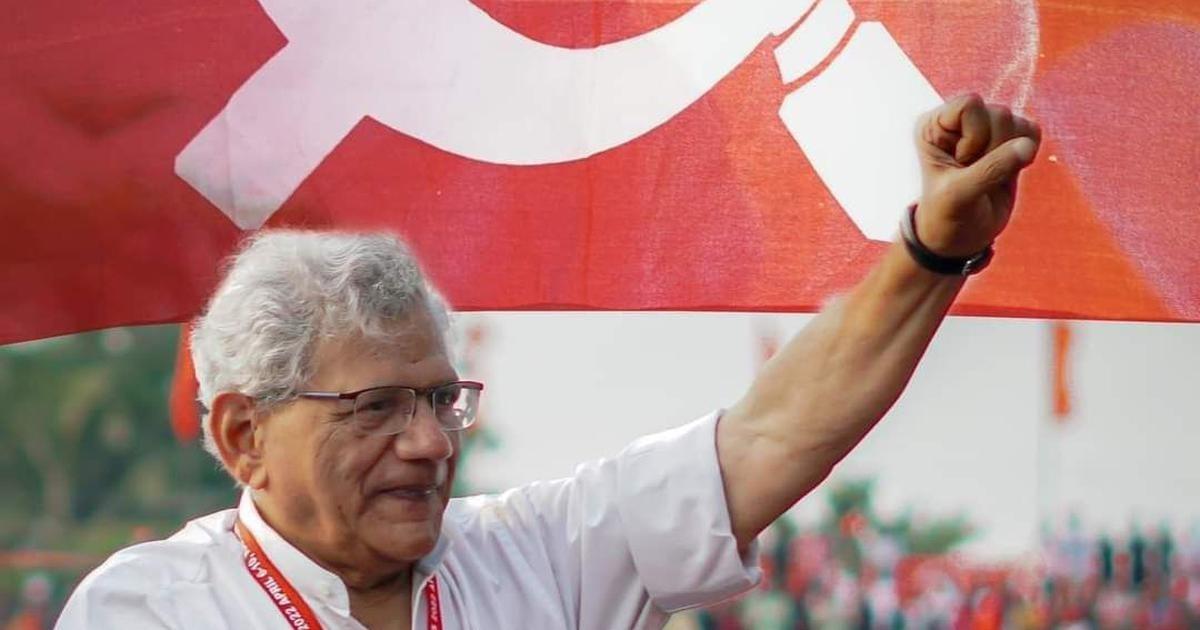
Why in News
Sitaram Yechury, General Secretary of CPI (M) and India's prominent Leftist leader, recently passed away on September 12, 2024, at the age of 72. He died at the All India Institute of Medical Sciences (AIIMS) in New Delhi after battling an acute respiratory tract infection.
Personal Life
- Sitaram Yechury (12 August 1952 – 12 September 2024) was an Indian Marxist politician and General Secretary of the Communist Party of India (Marxist).
- He was born in Madras (now Chennai) into a Telugu Brahmin family.
- His father, Sarveswara Somayajula Yechury, worked as an engineer, and his mother, Kalpakam Yechury, was a government officer.
- Yechury spent his early years in Hyderabad, where he completed his schooling.
- He later moved to Delhi due to the Telangana agitation in 1969.
- He went on to study Economics at St. Stephen’s College and later at Jawaharlal Nehru University (JNU), where his political career took roots.
Political Journey
- Yechury’s political involvement began during his time at JNU when he joined the Students' Federation of India (SFI) in 1974, and a year later, he became a member of CPI(M).
- His opposition to the Emergency (1975-1977) led to his arrest.
- After the Emergency, Yechury emerged as a prominent student leader and was elected president of the JNU Students' Union multiple times
- In 1978, Yechury was elected as All-India Joint Secretary of SFI, and went on to become the All India President of SFI.
- In 1984, he was elected to the Central Committee of the CPI(M).
- He left the SFI in 1986.
- He was then elected to the Politburo in 1992
- He was elected to the Rajya Sabha representing West Bengal in July 2005, serving with distinction until 2017.
- He was elected as fifth General Secretary of CPI(M) at the party's 21st party Congress in Visakhapatnam on 19 April 2015.
- He was again re-elected as General Secretary of CPI(M) in April 2018 and again for the third time in April 2022.
Key Contributions
- He worked with P. Chidambaram to draft the common minimum program for the United Front government in 1996.
- He played important role during the formation of the UPA in 2004.
- He edited party's fortnightly newspaper People's Democracy for 20 years.
- He received the Best Parliamentarian Award in 2017.
Sitaram Yechury's Views
Yechury was a strong critic of U.S. foreign policy and opposed President Barack Obama's visit as the chief guest for the 2015 Republic Day parade.
He was also a staunch critic of abrogation of article 370 and 35A in Jammu and Kashmir.
About CPI (M)
- It is the largest communist party in India in terms of membership and electoral seats.
- The Communist Party of India (Marxist) was founded in 1964 following a split from the Communist Party of India.
- Puchalapalli Sundarayya and E. M. S. Namboodiripad are founder of CPI (M).
- Students' Federation of India (SFI) and Tribal Students Union (TSU) are student wings of CPI (M).
What is Communism?
communism is a political system where the community, rather than individuals, owns and controls things like factories, farms, and services. .
The goal of communism is to get rid of class differences by creating a society where no one is richer or poorer than others.
All property and wealth are controlled by the community as a whole, not by private individuals.
Karl Marx is known as the father communism.
karl Marx's most significant works include "Das Kapital" and "The Communist Manifesto
Other Political Ideologies:
Caitalism:
- Capitalism is an economic system where individuals or private businesses own and control things.
- The goal of capitalism is to make a profit, and it operates on the principles of free markets, competition, and supply and demand.
- Adam Smith is considered the father of capitalism, who wrote "The Wealth of Nations" in 1776.
Socialism:
- In Socialism, the government or community owns and controls factories, businesses, and resources.
- A central authority (like the government) plans and manages how things are produced and shared, aiming to make things fair for everyone.
- In communism, everything is owned and controlled by community but in socialism, the government plays a strong role in managing the economy.
Liberalism:
- Liberalism believes in individual freedom, equal rights, and limited government control.
- It emphasizes personal liberties, such as freedom of speech, religion, and the right to vote
- The father of liberalism is often considered to be John Locke
Feminism:
- Feminism is a social and political movement that fights for equal rights and opportunities for women.
- It aims to end gender-based discrimination and ensure that women have the same opportunities as men.


