What Happened?
Successful Docking in Space:
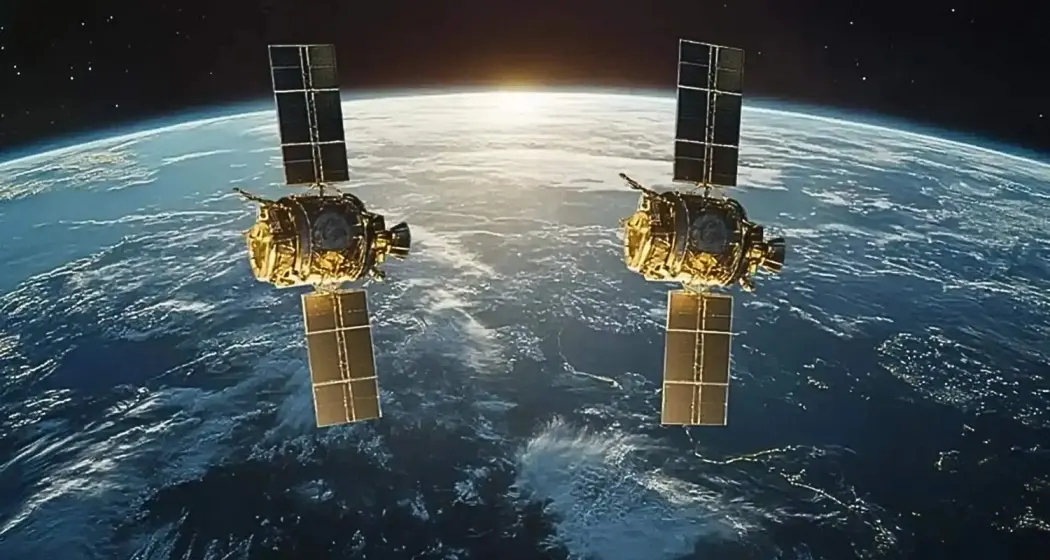
On January 16, ISRO successfully demonstrated a space docking mission called SpaDeX (Space Docking Experiment).- What is Docking?
Docking is when two spacecraft (or satellites) moving at very high speeds in space are brought to the same orbit, aligned, and joined together. - Key Details of the Experiment:
- Two small satellites, each weighing 220 kg, were brought 3 meters apart in orbit.
- They were joined using an extended ring that locked them together.
- After docking, ISRO gave commands to both satellites as if they were one combined unit.
- What is Docking?
Global Achievement:
With this, India became the fourth country (after the USA, Russia, and China) to achieve space docking capability.
Why is Docking Important?
Future Space Missions:
Docking is a critical technology for ambitious missions like:- Space stations (where separate modules are assembled in orbit).
- Transporting crew and supplies to space stations.
- Heavy spacecraft launches that need multiple parts to be joined in orbit.
India's Future Goals:
- Bharatiya Antariksha Station: India plans to build its own space station by 2035. This will require docking to assemble multiple modules in space.
- Chandrayaan-4: A future Moon mission to bring back lunar samples will need docking between different modules in space.
- Human Moon Mission: India’s planned human mission to the Moon will also rely on docking technology.
The First Docking in Space: Historical Perspective
USA (1966):
- NASA’s Gemini VIII mission was the first to achieve docking with another vehicle (Agena).
- It was a crewed mission led by Neil Armstrong, who later became the first human on the Moon.
USSR (1967):
- The Soviet Union performed the first automated docking with uncrewed spacecraft Kosmos 186 and Kosmos 188.
China (2011):
- China’s unmanned Shenzhou 8 docked with the Tiangong 1 space lab.
- In 2012, China achieved its first crewed docking with the Shenzhou 9 mission.
What Happened During ISRO’s Docking Experiment?
Key Steps:
- Two satellites, SDX01 (Chaser) and SDX02 (Target), were used.
- They were gradually brought closer using precise maneuvers:
- Held at distances like 5 km, 1.5 km, 500 m, 225 m, 15 m, and finally 3 m.
- The docking mechanism joined them at 3 meters.
Further Steps:
- After docking, ISRO tested command control as a single unit.
- Next, ISRO will test:
- Sharing power between satellites.
- Undocking: Separating the satellites to continue their individual experiments.
Challenges Faced:
- Initial attempts (January 7 and 9) failed due to drifting issues.
- After repeated simulations and corrections, docking was successfully achieved.
What is the Bharatiya Docking System?
Unique Features:
- The system is androgynous, meaning both satellites have identical docking systems.
- It uses two motors, unlike the 24 motors in the international docking systems.
Advanced Sensors and Processors:
- Laser Range Finder, Rendezvous Sensor, Proximity and Docking Sensor: These measure the distance and position of satellites accurately.
- New Processor: Helps calculate satellite positions and speeds, paving the way for future autonomous docking without navigation support.
Why Was This Mission Crucial?
Preparing for India’s Space Station (2028):
The first robotic module for the Bharatiya Antariksha Station is set to launch in 2028, and docking will be key to assembling the station.Next Lunar Missions:
- Chandrayaan-4 (Moon sample return mission) will rely heavily on docking between multiple modules for transporting samples back to Earth.
Future Lunar Human Missions:
Docking will allow human missions to carry supplies and return safely to Earth.
Key Terms to Remember
- SpaDeX: Space Docking Experiment by ISRO.
- Docking: Joining two spacecraft in space.
- Bharatiya Docking System: India’s indigenous docking system.
- Bharatiya Antariksha Station: India’s planned space station by 2035.
- Chandrayaan-4: Upcoming Moon mission to bring back lunar samples.
This mission marks a giant leap in India’s space capabilities, demonstrating its readiness for complex, long-term space endeavors.